


Every November, the nation grinds to a halt for its well-known university admissions test.
Shops are shut, flights are delayed to minimize noise, and even the rhythm of the morning commute decelerates for the test-takers.
As evening approaches, most test-takers exit of examination centers, breathing a sigh of relief and greeting the relatives waiting outside.
But not everyone concludes at that hour. After night has fallen and evening arrives, some students remain in the exam room – finishing close to 10pm.
They are the visually impaired examinees, who frequently spend over half a day completing the longest version of the college entrance exam.
The Endurance Test
This week, more than 550,000 examinees nationwide will sit for the CSAT – a shortened form for university admissions exam in the local language. This represents the largest figure of applicants in almost a decade.
This examination doesn't just determine if students can enter college, but may influence their career opportunities, income, where they will live and even future relationships.
Based on their selected disciplines, examinees answer roughly two hundred questions across language, mathematics, English, social or natural sciences, an additional foreign language, and Chinese characters.
Typically, it is an full-day endurance test of back-to-back tests. Starting the Suneung test at 08:40 and conclude around 17:40.
Blind students with severe visual impairments, though, are given 1.7 times the regular exam time.
This means, if they take the additional foreign language section, the test can finish as far as 9:48 PM – nearly 13 hours after it began.
There is no dinner break; the test continues straight through.
The physical bulk of the braille test papers further extends the length.
As each phrase, mark and diagram is transformed into braille, every exam document transforms into six to nine times more voluminous than the standard equivalent.
Student Perspectives
At Seoul Hanbit School for the Blind, 18-year-old Han Donghyun is one of the students who are preparing for the most extended form of the exam this year.
Last year, there were over a hundred blind test-takers nationwide – ninety-nine with low vision and twelve with severe visual impairments like the student – according to data from the ministry.
The student was born completely blind and is unable to perceive light.
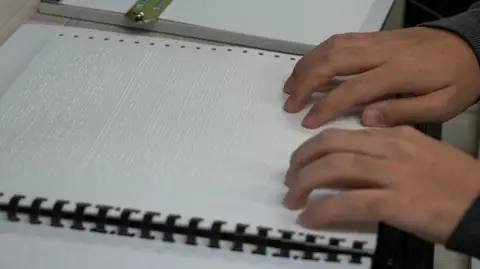
When meeting on campus, his hands moved rapidly across a braille practice booklet of previous test problems.
Approaching the examination date, he was focused on managing his endurance and physical state. He will take the exam using braille test papers and a audio assistance device.
"The fatigue is significant because the exam is so long," he mentioned. "However, no unique method exists. I just follow my study schedule and attempt to maintain my well-being. That's the only way."
Dong-hyun said the language component is especially challenging for him.
A standard test booklet for this part is about 16 pages – but the tactile edition is roughly 100 pages long.
Even with screen-reading software, spoken information vanishes as soon as it is heard, contrary to written content that can be viewed and re-read. Dong-hyun has to hold the details in his recall as he progresses.
Math component is equally demanding.
He must interpret complex graphs and tables that have been converted into tactile format, solely through his touch.
Nevertheless, he noted that conditions have improved than they were previously. Historically, students had to do nearly every calculations in their memory. However, recently, blind test-takers have been allowed to use a braille notetaker, called the assistive tool.
"Similar to those with vision document their calculations in pencil, we input them in tactile format on the device to track progress," he said.

Endurance Challenges
Another student at the institution, teenage a test-taker, who will also sit the Suneung this year, said the evening hours are "the hardest point" of the session.
"Up until lunch, it's manageable," he said. "But around 4 or 5pm, following language sections and before Korean History, that's when it gets really tough.
"There's no dinner break," he explained. "We're solving problems during the time we would typically dine, so fatigue increases. Nevertheless, I persist because I know there will be a feeling of achievement at the end."
For Jeong-won, the fatigue is intensified by the need to stay intensely focused with tactile input and his hearing.
"When I'm reading the braille with my hands and simultaneously receiving content through audio, it feels significantly more exhausting than experienced by those with vision," he described.
Study Challenges
But the students say that the length of the exam and the long study hours are not the hardest part. The main difficulty is availability of learning resources.
Popular textbooks and online lectures that those with vision depend on are frequently out of reach.
Limited numbers of tactile editions, and transforming resources into audio requires having text files – which are difficult to obtain. In many cases, individuals must manually type entire workbooks to make them usable.
Digital instruction also pose difficulties, as many instructors explain concepts using visual notes, illustrations and images on screen, which cannot be followed through audio alone.
One of the most significant barriers, however, is the postponement in receiving braille versions of the government-issued study materials – a core set of resources closely linked to the standardized test.
Due to this postponement, blind students often receive the resources months later than others.
"Sighted students get their EBS books early in the year and study them for the entire period," said Jeong-won. "We obtain the braille files approximately in August or September, when the test is approaching quickly."
Dong-hyun expressed the identical worry.
"Tactile resources weren't completed until less than 90 days before the exam," he mentioned. "I kept wishing the production timeline would accelerate."
The responsible organization, which produces the tactile edition of EBS exam materials, stated that the process takes at least 90 days for every volume because it needs to adhere to relevant guidelines.
The institute further mentioned that it is "making various efforts to guarantee that blind students can study without disruption, such as producing and supplying the resources in individual sections."
An advocacy group said it has long raised these concerns with {author


